Today, we explored photographs from Kabul, Afghanistan. We saw pictures of the rich history and heritage of the capital city of Afghanistan, and yet we also saw images of life under the Taliban rule. Afterwards, you each chose a side to discuss and debate the presence of American and foreign forces in Afghanistan.
I appreciated your sensitive, insightful, and astute comments--in many cases based on the current news articles about Afghanistan that you found, annotated, and shared with us in class.
For tonight, read through Chapter 3 of The Breadwinner, and afterwards, make a prediction, below, about what will happen to Parvana's father. Do you think he will be released from prison? Detained? Something worse? Share your idea and why you think so, below.
Thursday, February 26, 2015

Tuesday, February 24, 2015
Beginning The Breadwinner
Today, we began our novel, The Breadwinner by Deborah Ellis. We worked in small groups to share our facts about the author Deborah Ellis, and we learned that she conducted extensive reporting from Afghan refugee camps. This reporting helped inspire her to write The Breadwinner, the royalties from which she donates entirely to Women for Women International.
Now that we have explored Chapter 1 together, share your ideas, below, on which character you would most want to meet so far: Nooria, the high school students who is very upset by what has happened? Parvana, who at first likes not going to school, but then comes to see it as a terrible fate? Their father, whose leg has been lost to a bomb, yet still seems to retain hope and even a sense of humor?
Even though these characters are facing terrible circumstances, each already shows bravery and courage.
Choose which of these characters you would want to meet, and share what you might ask them or what you might want to talk about below. Why would you choose this person and why would you want to talk about these questions?
Our word for the day today was OBFUSCATE, which means to hide, and our word for the day yesterday was ASTUTE, which means understanding or able to comprehend clearly.
Now that we have explored Chapter 1 together, share your ideas, below, on which character you would most want to meet so far: Nooria, the high school students who is very upset by what has happened? Parvana, who at first likes not going to school, but then comes to see it as a terrible fate? Their father, whose leg has been lost to a bomb, yet still seems to retain hope and even a sense of humor?
Even though these characters are facing terrible circumstances, each already shows bravery and courage.
Choose which of these characters you would want to meet, and share what you might ask them or what you might want to talk about below. Why would you choose this person and why would you want to talk about these questions?
Our word for the day today was OBFUSCATE, which means to hide, and our word for the day yesterday was ASTUTE, which means understanding or able to comprehend clearly.
Thursday, February 12, 2015
Rounding the Bend with Synthesis!
Today, we worked through a list of guidelines for writing, and began to revise our synthesis essays. Here is the list of 13 Writing Rules to keep in mind as you type and revise your paragraphs tonight.
Be sure to do as much revision as you can--but rest assured that you will be able to keep revising after this first final draft comes in.
Also, be sure to staple any rough draft work you've done throughout the process of writing our synthesis essays. Remember that I LOVE seeing the journey you've gone through to get the product you staple on top. It's not just about the finished end result with writing; it's also about showing what you've come through, the ways you've revising, and what you've learned that counts.
I am looking forward to seeing your typed first final drafts tomorrow. And we'll have some fun before you leave for February break!
Peace,
Mr. R
Be sure to do as much revision as you can--but rest assured that you will be able to keep revising after this first final draft comes in.
Also, be sure to staple any rough draft work you've done throughout the process of writing our synthesis essays. Remember that I LOVE seeing the journey you've gone through to get the product you staple on top. It's not just about the finished end result with writing; it's also about showing what you've come through, the ways you've revising, and what you've learned that counts.
I am looking forward to seeing your typed first final drafts tomorrow. And we'll have some fun before you leave for February break!
Peace,
Mr. R
Wednesday, February 11, 2015
Creatively Seeing Our Synthesis Statements in A World We Imagine...
Our final paragraph of our Synthesis Essay! Alright! You've all worked very hard to craft your synthesis statements, see their parts within Habibi and Emman uel's Gift, and to agree or disagree with how this synthesis plays out in other books, films, or in your own life.
Now, in our final synthesis paragraph, we're going bigger.
We're going bolder.
We're going bolder!
We're going into the land of imagination. As you work on your fifth paragraph of the synthesis essay tonight, the key question to ask is this: HOW COULD MY SYNTHESIS STATEMENT CHANGE THE WORLD?
In other words, if your synthesis statement were true, how would the world be different? We want to try and include three sentences that discuss your response as a way to close our essays.
Here is our back board from today, where we discussed how to begin this final paragraph, and also viewed the assignment sheet:


Now, in our final synthesis paragraph, we're going bigger.
We're going bolder.
We're going bolder!
We're going into the land of imagination. As you work on your fifth paragraph of the synthesis essay tonight, the key question to ask is this: HOW COULD MY SYNTHESIS STATEMENT CHANGE THE WORLD?
In other words, if your synthesis statement were true, how would the world be different? We want to try and include three sentences that discuss your response as a way to close our essays.
Here is our back board from today, where we discussed how to begin this final paragraph, and also viewed the assignment sheet:
Remember that the rough draft of paragraph five is due tomorrow. It doesn't have to be perfect! IN fact, it shouldn't be perfect! Because all good writing is rewriting. We will revise and workshop these paragraphs tomorrow, but give it your best shot to try and envision how your synthesis might play out in the world around you.
Here is an example of how I might think about this question:
When I was a freshman in high school, my high school cafeteria was completely segregated. The school I attended, Windsor High School, was about half black and half white, and during lunch, students separated based on their races. As a timid freshmen, seeing this self-segregation saddened and shocked me. I wondered why. If my synthesis statement were true in this high school world, my cafeteria would have looked very different. Students of all races would have sat with one another. Students' internal interests and ideas would have been elicited as far more important than their outward appearance.
Like I am asking all of us to attempt, this would be my own first-attempt at a final paragraph. I would revise.
Yes! Revision!
Tonight, give it your best shot to write creatively about how your synthesis could or would change the world around you.
And here is a picture of our front board, which we used to help guide our peer edit of paragraph four today:
And finally: our word of the day was EXACERBATE, which means to make worse. This verb can be used, for example, like this: If we get any more snow, it will exacerbate the driving conditions.
Have an awesome evening my amazing students!
Peace,
Mr. R.
Tuesday, February 10, 2015
Synthesis Alive in the World at Large!
Today, we peer-reviewed paragraph three of our synthesis essay and then created some possibilities for how to create paragraph four.
Here is the checklist we used to revise paragraph three of our essays:
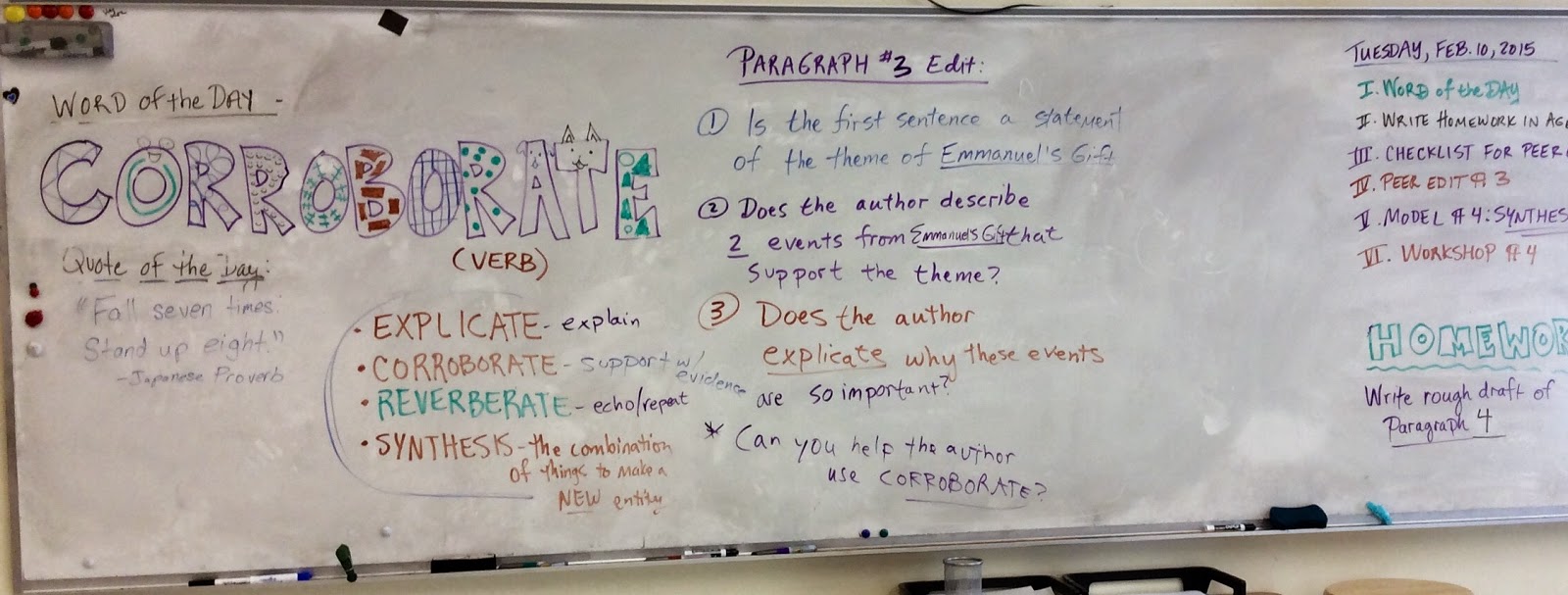
As you continue to think about your third paragraphs, check to see if you've revised according to the above questions. And then: use our vocab words within your essay this week!
As we dove into paragraph four, here are some of the possibilities we explored for how to begin the paragraph:

Here is the checklist we used to revise paragraph three of our essays:
As you continue to think about your third paragraphs, check to see if you've revised according to the above questions. And then: use our vocab words within your essay this week!
As we dove into paragraph four, here are some of the possibilities we explored for how to begin the paragraph:
And the work of paragraph four gets us back into the realm of creativity. (Score!) Since we are no longer working with our class novel or the documentary for this paragraph, we need to state whether we agree or disagree with this synthesis statement using the world at large as our support!
You can use examples from your own life, from other books you have read, movies you have seen, events you have learned about in Mrs. Dyer's History class, or Mr. Holt's Science class, or Mr. Desarro's Math class. You can even create a hypothetical situation that shows why you agree or disagree.
After all, that's what Socrates did to prove his point in "Plato's Allegory of the Cave." Imagine Socrates saying to his listeners, So, let's say there's this cave, see, and everyone inside is...
Our word of the day today is CORROBORATE, which simply means to support with evidence. Be sure you corroborate your ideas in paragraph four of our synthesis essay.
For tomorrow, be sure to have a rough draft of paragraph four ready for a peer review.
Exciting stuff!
Peace,
Mr. Reynolds
Thursday, February 5, 2015
Getting to Paragraph Two in Synthesis
Alright! Today we sauntered our past past paragraph one in our synthesis essays and arrived--not yet exhausted--at paragraph two. Here is the link for some examples of our first paragraph synthesis statements, which we worked on yesterday. And here is the synthesis assignment (in case space gnomes have stolen it).
And HERE is a link to a video on how to create your synthesis statement for your introductory paragraph in case you need a review or were absent.
Today, we worked on crafting topic sentences for our second paragraphs for our synthesis essays. The rough draft of paragraph two is due tomorrow, and here is an example from our back whiteboard of the process:


And HERE is a link to a video on how to create your synthesis statement for your introductory paragraph in case you need a review or were absent.
Today, we worked on crafting topic sentences for our second paragraphs for our synthesis essays. The rough draft of paragraph two is due tomorrow, and here is an example from our back whiteboard of the process:
The cool thing about synthesis is that--since A + B = C--we already have our topic sentences for Habibi. It's going to be what we used for A yesterday! This second paragraph explores the theme of Habibi on its own terms, and our work is to prove why this theme is actually IN the novel (using two events from the novel).
Also, before diving in to paragraph two today, we did some editing of our first paragraphs. Here is a picture of our front whiteboard, with the questions we used to revise our first paragraphs:
And last but not least, our word of the day today was ELICIT, which means to draw out by clever questioning--as in this example: The lawyer elicited the real story during a thirty-minute cross-examination.
Wednesday, February 4, 2015
AAAAHHHH! What is Synthesis!? And how do I create a Synthesis Essay?! Aaaahhhh!
Lovely Students!
If you are trying to write your introductions for this synthesis essay assignment, and you are beginning to wonder if Mr. Reynolds is insane, or if synthesis is even a real thing or not, cease and desist!
It is going to be okay. We will get through synthesis together. And forever afterwards, whenever you hear the word SYNTHESIS, you will smile a wide, knowing smile, rub your chin, and say, "Synthesis and I, we're old friends, we are."
You might also say, "Synthesis? I've taken Synthesis around the dance floor for a few twirls. I surely have."
You might even find yourself saying, "Synthesis changed my life forever. In a good way. In a great way. I see the world, now, through the lens of SYNTHESIS."
Can't envision yourself saying any of that stuff? Really? Did you try actually saying that stuff out loud? You did? And that didn't work? Hhhhhhmmmm.
It might be because we need more practice! Yes! As you are working on writing your introductory paragraphs tonight for your synthesis essay, here is a video which goes over some of the key ideas that we explored in class today. It walks through one example of how to create a synthesis essay.
Here goes!
If you'd prefer to watch the video via link, click here and you'll see the same video explanation of synthesis! Yes!
And if you would like to check out some of the models we created in class, here you go! These are some examples of how we found thematic statements for our two texts, and then put them together to create a Synthesis statement.
Our word for the day is REVERBERATE, which means to echo, or to continue onward even after the action /words have ended. An example of our word in a sentence is this: A kind action can reverberate for years.
If you are trying to write your introductions for this synthesis essay assignment, and you are beginning to wonder if Mr. Reynolds is insane, or if synthesis is even a real thing or not, cease and desist!
It is going to be okay. We will get through synthesis together. And forever afterwards, whenever you hear the word SYNTHESIS, you will smile a wide, knowing smile, rub your chin, and say, "Synthesis and I, we're old friends, we are."
You might also say, "Synthesis? I've taken Synthesis around the dance floor for a few twirls. I surely have."
You might even find yourself saying, "Synthesis changed my life forever. In a good way. In a great way. I see the world, now, through the lens of SYNTHESIS."
Can't envision yourself saying any of that stuff? Really? Did you try actually saying that stuff out loud? You did? And that didn't work? Hhhhhhmmmm.
It might be because we need more practice! Yes! As you are working on writing your introductory paragraphs tonight for your synthesis essay, here is a video which goes over some of the key ideas that we explored in class today. It walks through one example of how to create a synthesis essay.
Here goes!
If you'd prefer to watch the video via link, click here and you'll see the same video explanation of synthesis! Yes!
And if you would like to check out some of the models we created in class, here you go! These are some examples of how we found thematic statements for our two texts, and then put them together to create a Synthesis statement.
Our word for the day is REVERBERATE, which means to echo, or to continue onward even after the action /words have ended. An example of our word in a sentence is this: A kind action can reverberate for years.
Thursday, January 29, 2015
Finding Meaning and Connecting Messages
Today, we continued screening our documentary film, Emmanuel's Gift. The documentary explores the life of Emmanuel Ofosu Yeboah, who first rode 400 miles, across the entire country of Ghana, to change perceptions about people with physical challenges.
As we finish the documentary tomorrow, we will begin to connect the film to our novel, Habibi, and start to practice synthesis for our next writing assignment. How do these two powerful, remarkable stories work together to create a new message?
Along with our synthesis essay, we will be exploring how change actually occurs in the world. How do people, perceptions, and policies authentically change to become better?
There was no word of the day today as we were progressing with the documentary. See you all tomorrow for the finish!
Peace,
Mr. R
As we finish the documentary tomorrow, we will begin to connect the film to our novel, Habibi, and start to practice synthesis for our next writing assignment. How do these two powerful, remarkable stories work together to create a new message?
Along with our synthesis essay, we will be exploring how change actually occurs in the world. How do people, perceptions, and policies authentically change to become better?
There was no word of the day today as we were progressing with the documentary. See you all tomorrow for the finish!
Peace,
Mr. R
Monday, January 26, 2015
Synthesis Essay! (And Changing the World)
Today, we began a discussion of our next writing project: the SYNTHESIS essay! After our reading of HABIBI, we will screen a remarkable documentary entitled EMMANUEL'S GIFT, which reveals the story of Emannuel Ofosu Yeboah. Born with a deformed leg, Emmanuel's mission is to change the country of Ghana's perceptions and laws about people with physical deformities.
After we screen the film, we will begin our SYNTHESIS ESSAY (click here for the essay assignment in case you need to review it, lost a copy, or would like to use it for wrapping paper, love notes, or wall paper for your bedroom walls).
In unison with our essay assignment, our word for the day is SYNTHESIS, which simply means the combination of two things in order to produce a new, fresh, whole thing! Yes! Think: A + B = C. An example of our word in a sentence is: my wife and I ran a half-marathon recently; alone, we would have quit, but the synthesis of our energy and hope helped us both to finish!
After we screen the film, we will begin our SYNTHESIS ESSAY (click here for the essay assignment in case you need to review it, lost a copy, or would like to use it for wrapping paper, love notes, or wall paper for your bedroom walls).
In unison with our essay assignment, our word for the day is SYNTHESIS, which simply means the combination of two things in order to produce a new, fresh, whole thing! Yes! Think: A + B = C. An example of our word in a sentence is: my wife and I ran a half-marathon recently; alone, we would have quit, but the synthesis of our energy and hope helped us both to finish!
Friday, January 23, 2015
Of Socrates, Love, and Vocabulary...
This week, I loved hearing each of you share your sights, connections, and opinions about HABIBI and about the themes that emerged from the novel. Our Socratic Seminar yesterday was great fun--and I am very grateful that every single person shared their ideas. Huzzah!
We also explored the poem that I recited to my wife many years ago, and discussed its connections to Liyana and Omer's relationship in HABIBI.
Our word of the day today is ADMONISH, which means to warn or criticize in a gentle way. Here is an example of the word in a sentence: my fifth grade teacher, Mr. Looney, admonished me as a writer, which helped me to feel encouraged and also grow to become a stronger writer.
The only homework for this weekend is to get outside and enjoy some fresh air, the wide sky, and the feel of possibility.
Our quote of the day is from Shakespeare's HAMLET, when a character named Polonious says, "This above all: to thine own self be true."
Class, have a great weekend.
Peace,
Mr. R
We also explored the poem that I recited to my wife many years ago, and discussed its connections to Liyana and Omer's relationship in HABIBI.
Our word of the day today is ADMONISH, which means to warn or criticize in a gentle way. Here is an example of the word in a sentence: my fifth grade teacher, Mr. Looney, admonished me as a writer, which helped me to feel encouraged and also grow to become a stronger writer.
The only homework for this weekend is to get outside and enjoy some fresh air, the wide sky, and the feel of possibility.
Our quote of the day is from Shakespeare's HAMLET, when a character named Polonious says, "This above all: to thine own self be true."
Class, have a great weekend.
Peace,
Mr. R
Friday, January 16, 2015
How a Flower Grows...
Today in class, we acted out some scenes from HABIBI, and had the chance to watch Omer and Liyana's relationship grow from introduction to interest to intimacy. Liyana remembers the hairs on the back of Omer's hand! Hairs on hand! And yet, as we learn today, Omer is Jewish. Liyana is Arabic.
Neither of them sees any problem with this, but already we sense the undertone from Liyana's parents. Specifically, Poppy says, "Never, never, never," (171).
For this long weekend, be sure to read up through page 208 in HABIBI. Then, after reading, share your ideas about the following question: If you were the author, Naomi Shihab Nye, what narrative decision would you make from here on out about Omer and Liyana's relationship? Why? And do you think their relationship is full of authentic love or not? Why?
Our word for today is FALLACY, which means a mistake, or mistaken thought, as in this line: Will it be a fallacy that Omer and Liyana think their cultures do not matter?
Neither of them sees any problem with this, but already we sense the undertone from Liyana's parents. Specifically, Poppy says, "Never, never, never," (171).
For this long weekend, be sure to read up through page 208 in HABIBI. Then, after reading, share your ideas about the following question: If you were the author, Naomi Shihab Nye, what narrative decision would you make from here on out about Omer and Liyana's relationship? Why? And do you think their relationship is full of authentic love or not? Why?
Our word for today is FALLACY, which means a mistake, or mistaken thought, as in this line: Will it be a fallacy that Omer and Liyana think their cultures do not matter?
Wednesday, January 14, 2015
Complexity...or Simplicity?
Today in class we talked about how our word of the day, LUGUBRIOUS (i.e. mournful, gloomy, dark) connects to Picasso's Guernica painting and to our novel, Habibi.
We then segued (remember that awesome word from a while back!?) into a Quick Write for five minutes, and then a discussion of Poppy's actions with the woman who claimed to be a distant relative. You all shared insightful comments about why Poppy acted with malice or with wisdom--and each class tended to be split on opinions about Poppy's actions.
Which makes us ask: are characters (including ourselves!) simple or complex? Are the characters we read about in any novel clear, easy to understand, and consistent? Or are the characters we read about complex, inconsistent, and unpredictable? If we believe William Shakespeare, then we'd say, with him, "Nothing is either good or bad, but thinking makes it so."
However, can we judge Poppy's actions--or those of any character in our novel or in our lives--without really knowing what it's like to walk in their shoes.
Let's think about this together after you finish your reading tonight (up to page 140 in Habibi). Once you've read, share your ideas about this question below: Liyana responds to the Jewish boy she meets in the marketplace, "I am with myself," (128). What do you think Liyana means by this? And would you say the same about yourself? Do you know yourself, and do you see yourself as simple or complex? How do you see Liyana and Poppy--simple or complex? Why?
Whoa, dude! Loads of questions coming at you from Mr. R tonight. And they are all in bold font!? What is with the bold, Mr. Reynolds!? And what is with the copious amount of questions!?
Have fun exploring them. Share what comes to mind and heart. I can't wait to read.
Peace!
Mr. R.
We then segued (remember that awesome word from a while back!?) into a Quick Write for five minutes, and then a discussion of Poppy's actions with the woman who claimed to be a distant relative. You all shared insightful comments about why Poppy acted with malice or with wisdom--and each class tended to be split on opinions about Poppy's actions.
Which makes us ask: are characters (including ourselves!) simple or complex? Are the characters we read about in any novel clear, easy to understand, and consistent? Or are the characters we read about complex, inconsistent, and unpredictable? If we believe William Shakespeare, then we'd say, with him, "Nothing is either good or bad, but thinking makes it so."
However, can we judge Poppy's actions--or those of any character in our novel or in our lives--without really knowing what it's like to walk in their shoes.
Let's think about this together after you finish your reading tonight (up to page 140 in Habibi). Once you've read, share your ideas about this question below: Liyana responds to the Jewish boy she meets in the marketplace, "I am with myself," (128). What do you think Liyana means by this? And would you say the same about yourself? Do you know yourself, and do you see yourself as simple or complex? How do you see Liyana and Poppy--simple or complex? Why?
Whoa, dude! Loads of questions coming at you from Mr. R tonight. And they are all in bold font!? What is with the bold, Mr. Reynolds!? And what is with the copious amount of questions!?
Have fun exploring them. Share what comes to mind and heart. I can't wait to read.
Peace!
Mr. R.
Subscribe to:
Posts (Atom)